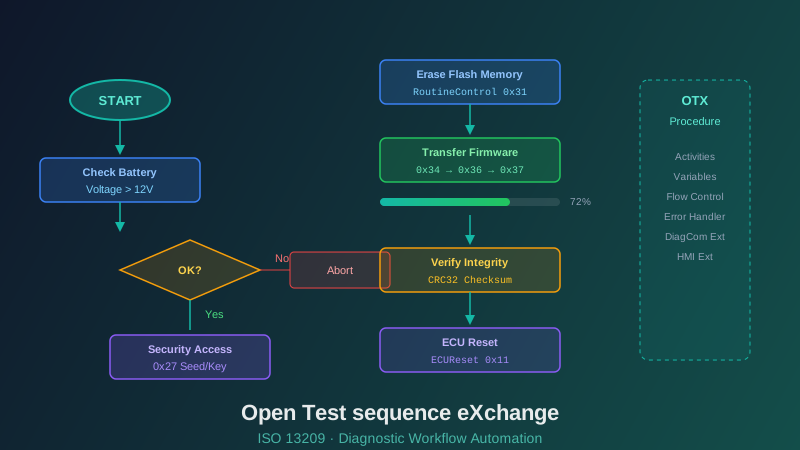
Understanding ODX: The Foundation of Standardized Vehicle Diagnostics
Open Diagnostic data eXchange (ODX) is the cornerstone of modern automotive diagnostics. Learn how this ASAM standard revolutionizes the way we describe and exchange diagnostic data.
In the world of automotive diagnostics, data standardization is not a luxury — it is a necessity. As vehicles grow more complex, with dozens of electronic control units (ECUs) communicating over multiple bus systems, the need for a universal diagnostic data format becomes critical. This is where ODX (Open Diagnostic data eXchange) enters the picture.
What Is ODX?
ODX, standardized as ISO 22901-1 and maintained by ASAM e.V. (Association for Standardisation of Automation and Measuring Systems), is an XML-based data format that describes the diagnostic capabilities of vehicle ECUs. It provides a manufacturer-independent way to encode everything a diagnostic tester needs to know: which services an ECU supports, how requests and responses are structured, how to interpret measured values, and how to perform complex diagnostic sequences.
Before ODX, each OEM and even individual teams within an OEM often maintained proprietary formats — custom binary files, spreadsheets, or home-grown databases. Integrating data from different sources was painful, error-prone, and expensive. ODX solves this by providing a single, well-defined schema that tools from any vendor can consume.
The ODX Layer Model
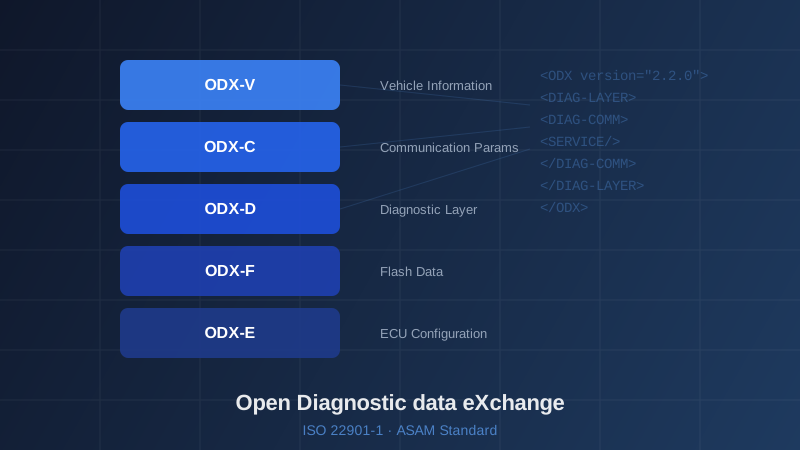
ODX organizes diagnostic data into distinct layers, each serving a specific purpose:
Vehicle Information (ODX-V) — Describes the vehicle itself: model variants, ECU configurations, and which diagnostic protocols apply to each configuration. This layer answers the question: "What am I diagnosing?"
Communication Parameters (ODX-C) — Defines the physical and data-link layer parameters required for communication. Bus type (CAN, Ethernet, K-Line), baud rates, timing parameters, and addressing schemes are all encoded here.
Diagnostic Layer (ODX-D) — The core layer. It contains the actual diagnostic services, data identifiers (DIDs), diagnostic trouble codes (DTCs), routine identifiers, and their complete request/response encoding. Each diagnostic service is described with its parameters, valid ranges, byte positions, and conversion formulas.
Flash Data (ODX-F) — Describes the procedures and data required for ECU reprogramming (flashing). Memory segments, security access sequences, download steps, and validation routines are defined here.
ECU Configuration (ODX-E) — Manages ECU variant coding and configuration data, allowing diagnostic tools to read, modify, and write configuration parameters.
Functional Groups (ODX-FD) — Enables grouping of diagnostic services across multiple ECUs by function rather than by physical ECU. For example, a "read all DTCs" function that queries every ECU in the vehicle simultaneously.
Why ODX Matters for Your Business
Adopting ODX is not just about compliance — it delivers tangible benefits. First, it dramatically reduces the cost of diagnostic tool development. When diagnostic data is standardized, runtime interpreters can be built once and reused across all vehicle platforms. Second, it improves data quality. The strict XML schema catches errors at authoring time rather than in the workshop. Third, it enables a competitive ecosystem. Multiple tool vendors can support the same vehicles, driving innovation and reducing costs for workshops and fleet operators.
At Nextera Automotive, we specialize in ODX authoring, validation, and integration. Whether you are starting from scratch or migrating from legacy formats, our team can help you build a robust ODX data pipeline that scales with your vehicle portfolio.
Getting Started
If your organization is considering ODX adoption, the key steps are: assess your current diagnostic data landscape, define your ODX data architecture (which layers you need and how they map to your ECU portfolio), select or build authoring and validation tools, and train your engineering teams. The investment pays for itself within the first vehicle platform — and compounds with every subsequent one.
Contact us to discuss how we can accelerate your ODX journey.