UDS Protocol Deep Dive: Mastering ISO 14229 for Vehicle Diagnostics
Unified Diagnostic Services (UDS) is the backbone of modern ECU communication. This deep dive covers service IDs, diagnostic sessions, security access, and real-world implementation patterns.
If ODX is the language in which we describe diagnostics, then UDS (Unified Diagnostic Services), defined by ISO 14229, is the protocol through which that language is spoken. UDS provides a standardized set of diagnostic services that every modern vehicle ECU implements, enabling everything from reading fault codes to reprogramming firmware.
UDS Architecture Overview
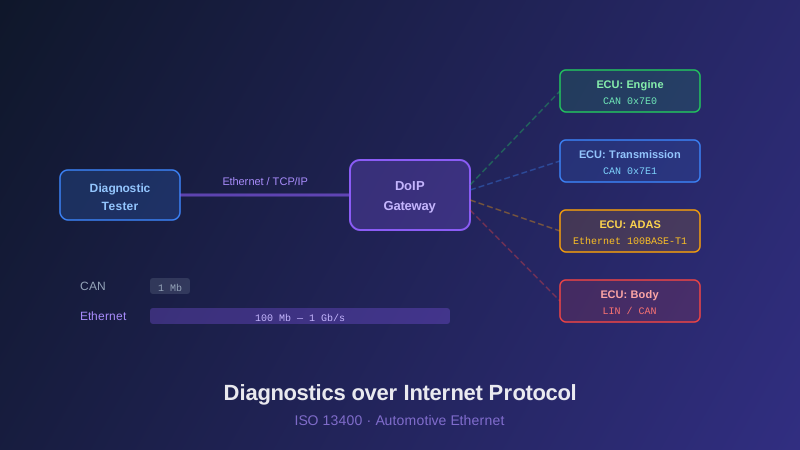
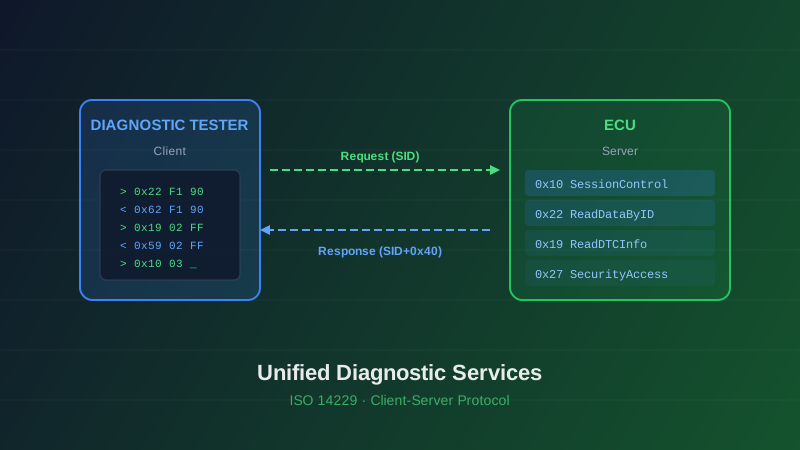
UDS operates on a client-server model. The diagnostic tester (client) sends requests to ECUs (servers) using well-defined service identifiers (SIDs). Each service has a request format and one or more response formats. The protocol is transport-agnostic — it works over CAN (ISO 15765), Ethernet/DoIP (ISO 13400), K-Line (ISO 14230), and other physical layers.
The beauty of UDS is its simplicity at the application layer. A diagnostic service request consists of a Service Identifier byte followed by service-specific parameters. The ECU responds with a positive response (SID + 0x40) containing the requested data, or a Negative Response Code (NRC) explaining why the request was rejected.
Key Diagnostic Services
DiagnosticSessionControl (0x10) — The gateway service. Before performing most operations, the tester must establish an appropriate diagnostic session. The default session allows basic read operations, while extended sessions unlock programming, calibration, or manufacturer-specific functions.
ReadDataByIdentifier (0x22) — The workhorse of vehicle diagnostics. This service reads data values identified by a 16-bit Data Identifier (DID). DIDs are the primary mechanism for accessing ECU parameters — from software version numbers to real-time sensor values like engine RPM, coolant temperature, or battery voltage.
ReadDTCInformation (0x19) — Reads diagnostic trouble codes and their associated status information. This service supports numerous sub-functions: reading all active DTCs, DTCs matching a specific status mask, DTC snapshots (freeze frames), and extended data records that capture ECU state at the moment a fault occurred.
SecurityAccess (0x27) — Implements challenge-response authentication to protect sensitive operations. The tester requests a seed from the ECU, computes the key using a secret algorithm, and sends it back. Only after successful authentication can protected services (like writing data or initiating flash procedures) be accessed.
RequestDownload (0x34) / TransferData (0x36) / RequestTransferExit (0x37) — The flash programming trilogy. These services orchestrate the process of reprogramming ECU firmware: negotiating the download, transferring data blocks, and finalizing the operation.
RoutineControl (0x31) — Triggers predefined routines within the ECU. Common uses include erasing flash memory before programming, verifying programmed data integrity, actuating physical components for testing, and running self-diagnostic routines.
Diagnostic Sessions and Service Access
UDS defines a session management concept that controls which services are available. In the default session, only basic read operations are permitted. Extended diagnostic sessions unlock additional capabilities, while programming sessions enable flash operations. This layered access model prevents accidental or unauthorized modifications to ECU behavior during normal vehicle operation.
Practical Implementation Tips
When implementing UDS communication in your diagnostic tool, there are several critical considerations. Response timing is paramount — ECUs specify P2 and P2* timing parameters that define how quickly they will respond. Exceeding these timeouts without proper handling leads to false communication failures. Multi-frame messages require careful management of flow control parameters. And security access implementations must account for failed attempt counters that can lock out the diagnostic interface.
At Nextera Automotive, we implement UDS stacks that handle all these edge cases gracefully. Our diagnostic runtime is battle-tested across multiple OEM platforms and supports the full range of ISO 14229 services.