SOVD: The Future of Service-Oriented Vehicle Diagnostics
Service-Oriented Vehicle Diagnostics (SOVD) represents the next generation of automotive diagnostic access. Learn how REST APIs, cloud connectivity, and service-oriented architectures are reshaping diagnostics.
The automotive industry stands at the threshold of a diagnostic revolution. For decades, vehicle diagnostics has operated through a well-established paradigm: a physical diagnostic tester connects to the vehicle's OBD port, communicates using protocols like UDS over CAN or DoIP, and interprets results using ODX data. This model has served the industry well, but the vehicles of tomorrow demand something fundamentally different. Enter SOVD (Service-Oriented Vehicle Diagnostics).
Why SOVD?
Modern vehicles are evolving into software-defined platforms. High-performance computing units (HPCs) run complex software stacks, including POSIX-based operating systems, containerized applications, and service-oriented middleware. These systems cannot be effectively diagnosed using traditional byte-level UDS services. They need diagnostic interfaces that understand software concepts: services, APIs, logs, configuration, and health monitoring.
Simultaneously, the connected car paradigm demands remote diagnostic capabilities. Over-the-air diagnostics, predictive maintenance based on cloud analytics, and remote software updates all require diagnostic access that extends beyond the physical OBD port. SOVD is designed from the ground up to address these needs.
SOVD Architecture
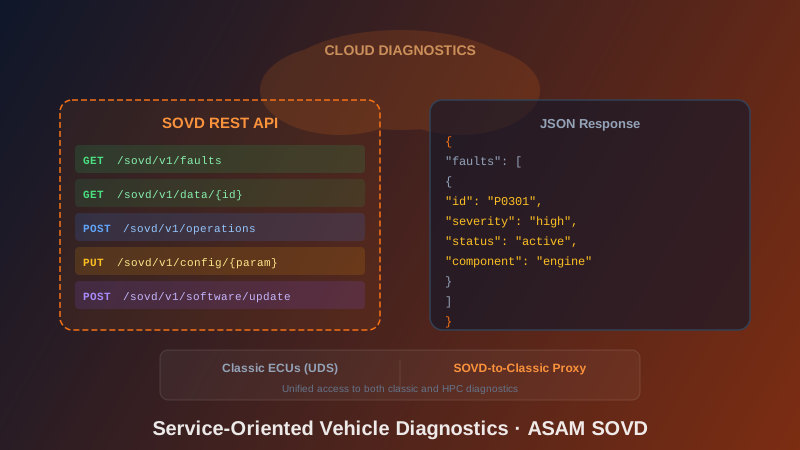
SOVD defines a RESTful API for diagnostic access. Instead of binary UDS messages, diagnostic operations are expressed as HTTP requests with JSON payloads. This approach leverages the vast ecosystem of web technologies — HTTP clients, JSON parsers, authentication frameworks, and API management tools — that every modern software developer already knows.
The SOVD API covers several functional areas: Fault Memory for reading and managing diagnostic trouble codes, Data for accessing diagnostic data values, Operations for triggering diagnostic routines and procedures, Configuration for managing ECU settings, Software Update for orchestrating firmware and software updates, and Logging for accessing system logs and diagnostic traces.
Critically, SOVD supports multiple access points. The same API can be exposed on the vehicle's internal Ethernet network (for workshop access), through a vehicle gateway to the cloud (for remote diagnostics), or directly on an HPC as a local service. This flexibility enables diagnostic scenarios that were previously impossible or impractical.
SOVD and Classic Diagnostics: Coexistence
SOVD does not replace UDS overnight. The ASAM standard explicitly addresses the coexistence scenario: vehicles will contain both classic ECUs (diagnosed via UDS/ODX) and high-performance computing units (diagnosed via SOVD). A SOVD-to-classic proxy component translates between the two worlds, exposing classic ECU diagnostics through the SOVD REST API. This allows diagnostic tools to present a unified interface regardless of the underlying diagnostic technology.
What This Means for the Industry
SOVD will fundamentally change how diagnostic tools are built and deployed. Web-based diagnostic applications become viable — imagine running diagnostics from a browser. Cloud-native diagnostic services can monitor vehicle fleets in real time. Third-party developers can build diagnostic apps using standard web development skills. And the barrier to entry for creating diagnostic solutions drops significantly.
At Nextera Automotive, we are actively investing in SOVD capabilities. Our engineering team is building SOVD server implementations, proxy components for classic diagnostic integration, and next-generation diagnostic tools that leverage the SOVD API. The future of diagnostics is service-oriented, and we are ready to help you navigate this transition.