Building Diagnostic Tools with the MCD-3 D-Server API
The ASAM MCD-3 D-Server API provides a standardized programming interface for diagnostic applications. Learn how this middleware layer simplifies diagnostic tool development.
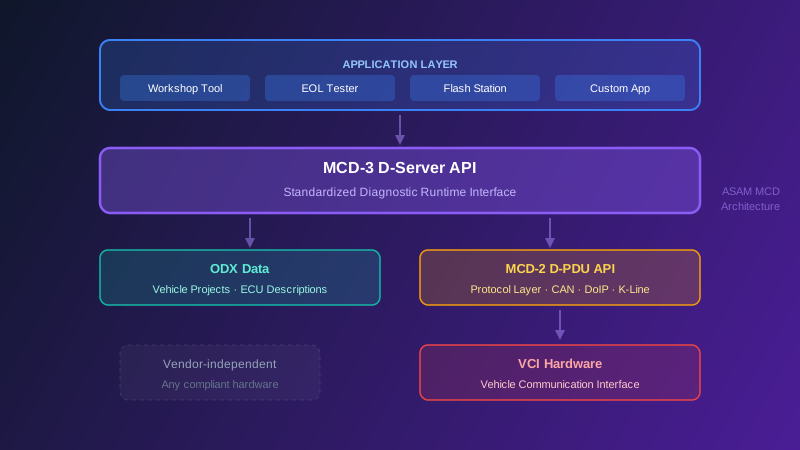
Developing a professional automotive diagnostic tool is a significant engineering effort. Your application needs to load and interpret ODX data, manage communication channels across multiple physical interfaces, handle protocol state machines for UDS, DoIP, and other protocols, and present diagnostic results to the user. Building all of this from scratch for each project is neither practical nor economical. This is why ASAM created the MCD-3 D-Server API.
What Is MCD-3 D-Server?
The MCD-3 D-Server (also known as the D-PDU API in its lower layers) is a standardized programming interface that sits between diagnostic applications and the underlying hardware and data infrastructure. Think of it as a middleware layer that handles the complexity of diagnostic communication so your application can focus on diagnostic logic and user experience.
The "MCD" stands for Measurement, Calibration, and Diagnostics — the three pillars of automotive electronics development. The "3" refers to the third layer in the ASAM MCD architecture, which deals with diagnostic runtime services.
Architecture and Layers
The MCD-3 architecture is layered for flexibility. At the top, the D-Server API provides high-level operations: load a vehicle project (ODX data), select a vehicle variant, establish communication with an ECU, execute diagnostic services, and interpret responses. The application developer works at this abstraction level.
Below the D-Server sits the D-PDU API (MCD-2), which manages protocol-level communication. It handles CAN frame assembly, UDS message segmentation, timing management, and transport protocol state machines. This layer abstracts the differences between communication protocols.
At the bottom, the Vehicle Communication Interface (VCI) hardware connects to the vehicle's diagnostic port. The D-PDU API communicates with the VCI through standardized driver interfaces, ensuring that diagnostic applications work with hardware from any compliant vendor.
Key Benefits for Developers
The primary benefit of building on MCD-3 is development speed. Instead of implementing ODX parsing, UDS stack, and hardware abstraction yourself, you leverage a proven runtime that handles these concerns. Your team can focus on what differentiates your tool: the user interface, diagnostic workflows, reporting, and fleet integration.
Interoperability is another major advantage. An application built on MCD-3 can work with any MCD-3-compliant server implementation, any D-PDU-compliant VCI hardware, and any ODX-compliant diagnostic data. This freedom of choice in components reduces vendor lock-in and procurement costs.
Our Approach
At Nextera Automotive, we have extensive experience with the MCD-3 ecosystem. We develop custom D-Server implementations optimized for specific use cases, build diagnostic applications on top of the MCD-3 API, and create integration layers that connect MCD-3 runtimes with enterprise systems. Whether you need a complete diagnostic tool or specific components of the MCD-3 stack, our engineering team can deliver.